Your agency should own the code, and it only does if the white label developer contract says so in writing: a signed assignment of copyright from the developer to you, triggered by a clear event such as final payment, so that you can pass those rights on to your client. Many contracts also call the job "work for hire", but under US law that label has a narrow meaning for outside contractors, so careful contracts pair it with an assignment instead of relying on it alone. The NDA sits beside the contract and covers what ownership clauses don't: who the client is, their customers' data, and the fact that you subcontract at all.
Have your own lawyer write or check the wording, especially if your agency and the developer are in different countries. I'm in Slovenia, so that applies to any agency hiring me.
What "work for hire" means for a contractor
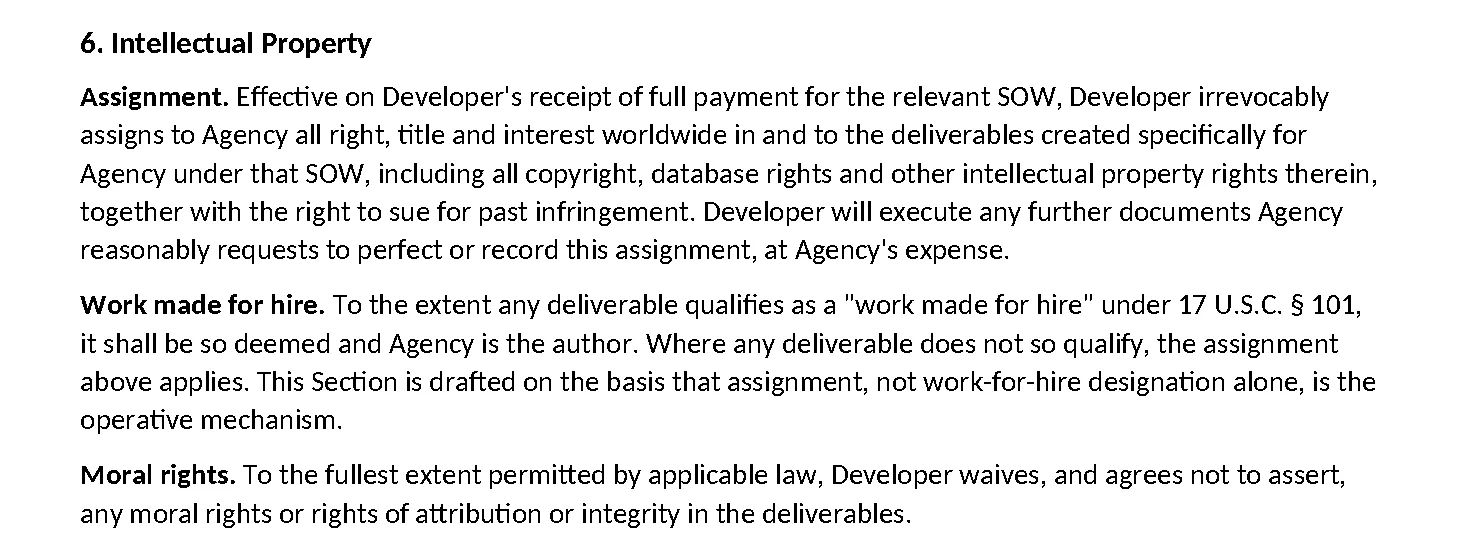
In US copyright law, a "work made for hire" is one where whoever paid for it is treated as its author from the start. For an employee's work done as part of the job, that happens automatically. For an independent contractor it is much narrower. The U.S. Copyright Office's Circular 30 explains that a commissioned work counts as made for hire only if it falls into one of nine categories listed in the statute and the parties agree in a signed written document that it is a work made for hire.
How I handle it. The NDA and the work-for-hire agreement are signed before I start, and all communication goes through you. The wording is on how I work; ask me for the contract if you want to read it first.
Whether a custom PrestaShop module or a WooCommerce checkout plugin fits one of those categories is a question for a lawyer, and I wouldn't want an agency's ownership to hang on the answer. The common approach is to say the work is made for hire to the extent the law allows, and that anything which doesn't qualify is assigned to the agency. An assignment is a straight transfer of ownership, and it should be in writing and signed by the developer.
Where the developer is abroad, their country may have its own rules on authorship and on which rights can be transferred at all. Broad wording ("all rights, title and interest, worldwide") and a governing law clause are the usual starting points, and that part of the contract should go in front of your lawyer before the rest.
Match the developer contract to your client contract
Your client probably expects to own their store's code, and your contract with them likely says so. You can only pass on rights you actually hold. If the developer contract says nothing about ownership, you may have promised the client something that legally still sits with a subcontractor they have never heard of.
Read your client contract first and write the developer contract to fit it: the same deliverables, the same kind of rights, and triggers that line up. If the client gets ownership on sign-off but you only get it from the developer on final payment, there is a stretch where you have promised rights you don't yet hold. The simplest place to close that gap is your own client contract, for example by tying the client's ownership to their final payment rather than to sign-off.
What the contract should say about ownership
Define the deliverables widely. Source code is the obvious part. Database changes, configuration, theme or template changes, design assets, documentation and handover notes are easy to leave out, and any one of them can matter later. Then say when ownership passes. Final payment is the usual trigger, and it's mine: everything I build is assigned to the agency on final payment, and I hand over the code with a short written summary.
Developers often reuse code they wrote before your job, such as helper functions or a small library. You won't own that, and you shouldn't expect to. What you need is a perpetual, irrevocable, royalty-free licence to use and modify it as part of the deliverable, with the right to pass that licence on to your client.
Ask for delivery of the actual source, including repository history if there is one, and for every credential the developer used to be returned or removed at handover. Ask for the handover obligation to apply however the contract ends, including early termination by either side. Add your right to modify the code and to have anyone else maintain it, with no permission needed from the original developer. If a developer stops answering, that clause and a current copy of the code are what let someone else pick the store up; I wrote about that situation in 'My developer went dark' is the risk that actually costs you the client.
What a white label NDA should cover
Sign the NDA before the brief goes out, not after the scope comes back. A brief usually includes the client's URL, sometimes admin access, and nearly always enough to identify the client. I sign an NDA before any brief, and any developer you hire should expect to.
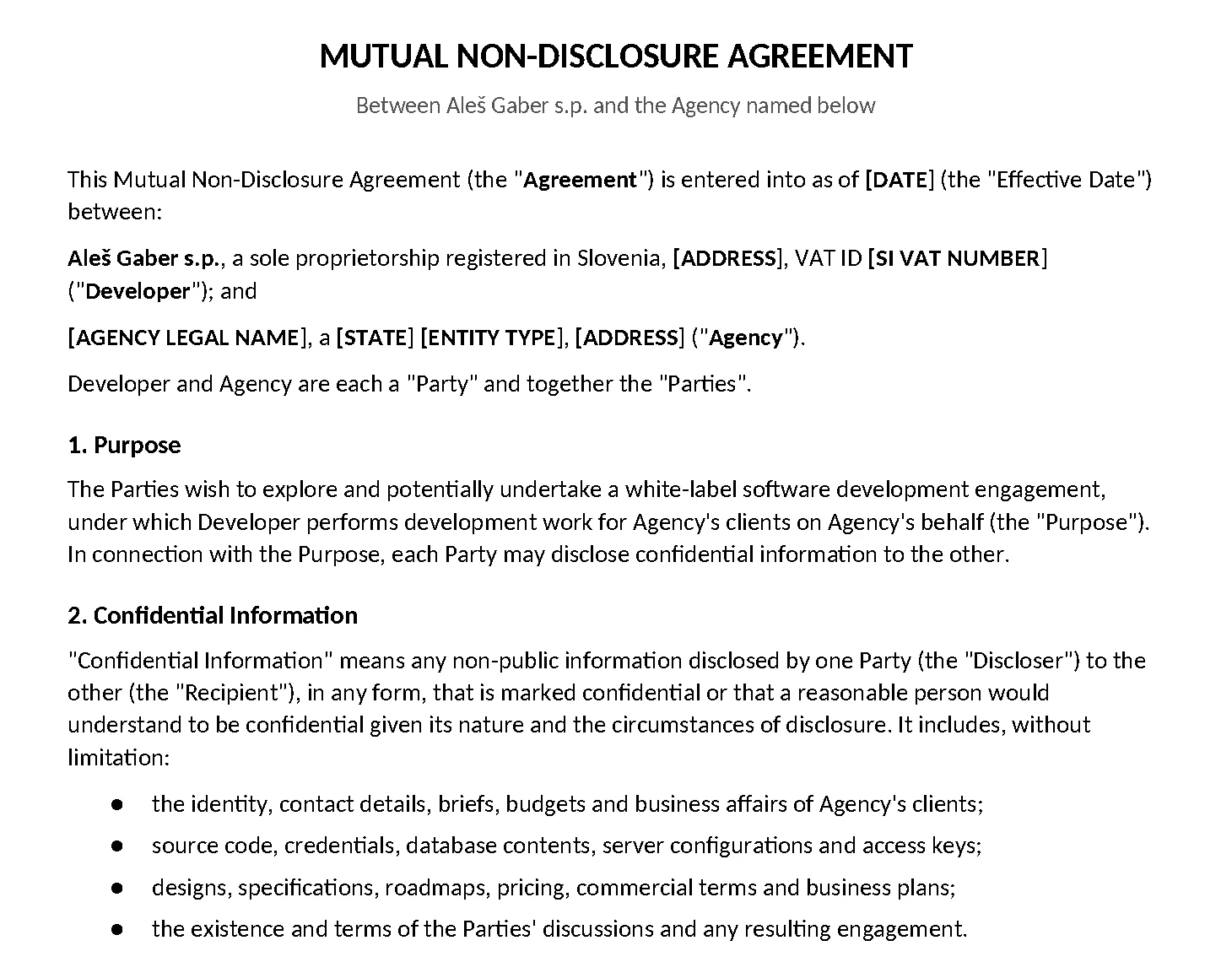
A useful white label NDA names what is confidential: the client's identity, their store and its data, the agency's own commercial details the developer sees along the way, and the subcontracting arrangement itself. It should also say confidentiality continues after the contract ends, since the client's name stays sensitive after the last invoice is paid.
Customer data needs its own clause, in the NDA or next to it. A copy of a live store carries real orders, names and addresses. You can ask that the data is used only for the job and that staging copies are deleted after handover. If you want the staging copy anonymised, that should be done on the copy only, after a fresh backup of the live store, and never by running a script against the live database. Deleting a staging copy doesn't touch the live shop, but check first that it isn't holding the only copy of work that hasn't been handed over yet.
The GDPR may apply as well, either because the store has customers in the EU or because the developer is established in the EU, as I am. Article 28 of the GDPR covers processors: paragraph 2 says a processor needs the controller's prior written authorisation before engaging another processor, and paragraph 4 says the same data protection obligations have to be imposed on that other processor by a contract or other legal act. Your client may already have a data processing agreement; ask your lawyer whether it can be extended to cover the developer.
Clauses that protect the client relationship
A no-contact clause says the developer doesn't contact your client. You can also ask for anything that reaches the developer from the client's side to be passed back to you without a reply. A non-solicitation clause stops the developer taking work from that client directly for a set period. I never contact an agency's client, and a developer who intends to work white-label for the long term shouldn't object to either clause.
Attribution is where names leak in ways people don't expect. A request for "no branding" is too vague to check. A developer's name or company can turn up in code comments and file headers, in the author field of commits, in module or plugin metadata, in the document properties of a PDF or spreadsheet, and in the address of a staging site. My name appears in none of those places, and I'd ask any developer to list them in the contract, because a list can be checked. A no-branding clause doesn't stop a developer showing the work in a portfolio or case study, so if you want that ruled out, give it its own line.
Payment terms, a liability cap and notice periods belong in the same document. Mine are net 15 in USD, liability capped, and 30 days' notice either side. Compare the developer's liability cap with what your client contract makes you liable for, because any gap between the two falls on your agency.
Third-party code that nobody in the chain owns
No contract gives you ownership of the platform itself, whether that is PrestaShop or WordPress with WooCommerce, or of commercial themes, modules and plugins, which come with whatever licence terms their sellers set. What you own is the custom work built on top. WordPress is distributed under the GPL, and WordPress.org's licence page says that licence sets requirements for derivative works such as plugins and themes. That doesn't take away your copyright in a plugin written for you, but if the plugin is ever distributed, GPL terms may come with it. If your client contract promises exclusivity, ask your lawyer how the two fit together.
Ask the developer to list at handover every third-party component they added and where it came from, so you can tell custom code from licensed code. Buy paid licences in the client's name or your agency's, not on the developer's personal account, otherwise the update key leaves with them.
On a store you've taken over from someone else, check whether your agency or the client ever received an assignment for the previous developer's modules and overrides. So you've inherited a PrestaShop client. Now what? covers what else to look at on those installs.
When the developer brings in help
A solo developer may need more hands on a bigger build. When a build is bigger than one person, I bring in people I've worked with for years, and the agency still deals only with me. Each extra person who writes code is another set of rights that has to reach you.
Ask whether anyone else will touch the code. If so, the contract can make the developer responsible for getting a written assignment from each helper and for their compliance with the NDA, so the rights pass to the developer and then on to you. Without that, part of the deliverable may belong to someone you have no contract with. Add it to your questions to ask a white-label developer before you send the first brief, alongside how staging and handover will work.
Got a brief like this? Tell me the URL, the platform and what's stuck, and I'll come back with scope and a price, NDA first if you want one. Send me a brief.