Tell the client the truth about the arrangement and keep the details that are yours to keep. Something like: "We work with a senior specialist developer on platform work like this. They work under our direction and under NDA, and we're responsible for the result." That answers the question, doesn't invent an in-house developer you don't have, and doesn't hand the client a name and a phone number.
I'd assume a client who asks wants to know two things: whether the person touching their store knows what they're doing, and whether you'll still be the one accountable if something goes wrong. The sentence above covers both.
Do agencies use white label developers, and should the client know?
They do. Subcontracting web development is an ordinary way to run an agency. You sell the strategy, the design, the project management and the relationship, and you bring in a specialist for the parts that need someone who has done that exact job many times. A PrestaShop upgrade, or an ERP integration that keeps failing, is the kind of work where that makes sense. PrestaShop is rare in the US, so an agency that inherits a PrestaShop client often has nobody suitable in-house and very few people to call.
White-label means the work goes out under your brand, with the developer's name kept off it. Nothing in that arrangement asks you to tell the client the developer is an employee. My view of white label agency transparency is that the client can know a specialist is involved, how that specialist is bound and who answers for the work, while the developer's identity stays between you and them unless a contract says otherwise.
Why the vague answer costs more than the honest one
The tempting reply is "our team handled it", said in a way that implies a developer on staff. It's short and nobody asks a follow-up. The trouble starts if the client finds out later, from a staff page with no developer on it, a careless remark in a meeting, or a search on LinkedIn. Then you're explaining why you implied a staff developer, which is a harder conversation than explaining a subcontractor would have been, and the client has a reason to re-check other things you've told them.
If the subcontractor is me. The NDA and the work-for-hire agreement are signed before I start, all communication goes through you, and my name appears nowhere in the deliverables. How I work has the details; send me a brief when you have one.
The honest answer costs very little. Clients hire an agency for a result and for someone to hold responsible. Saying you use a specialist speaks to the first, and saying you're accountable keeps the second intact.
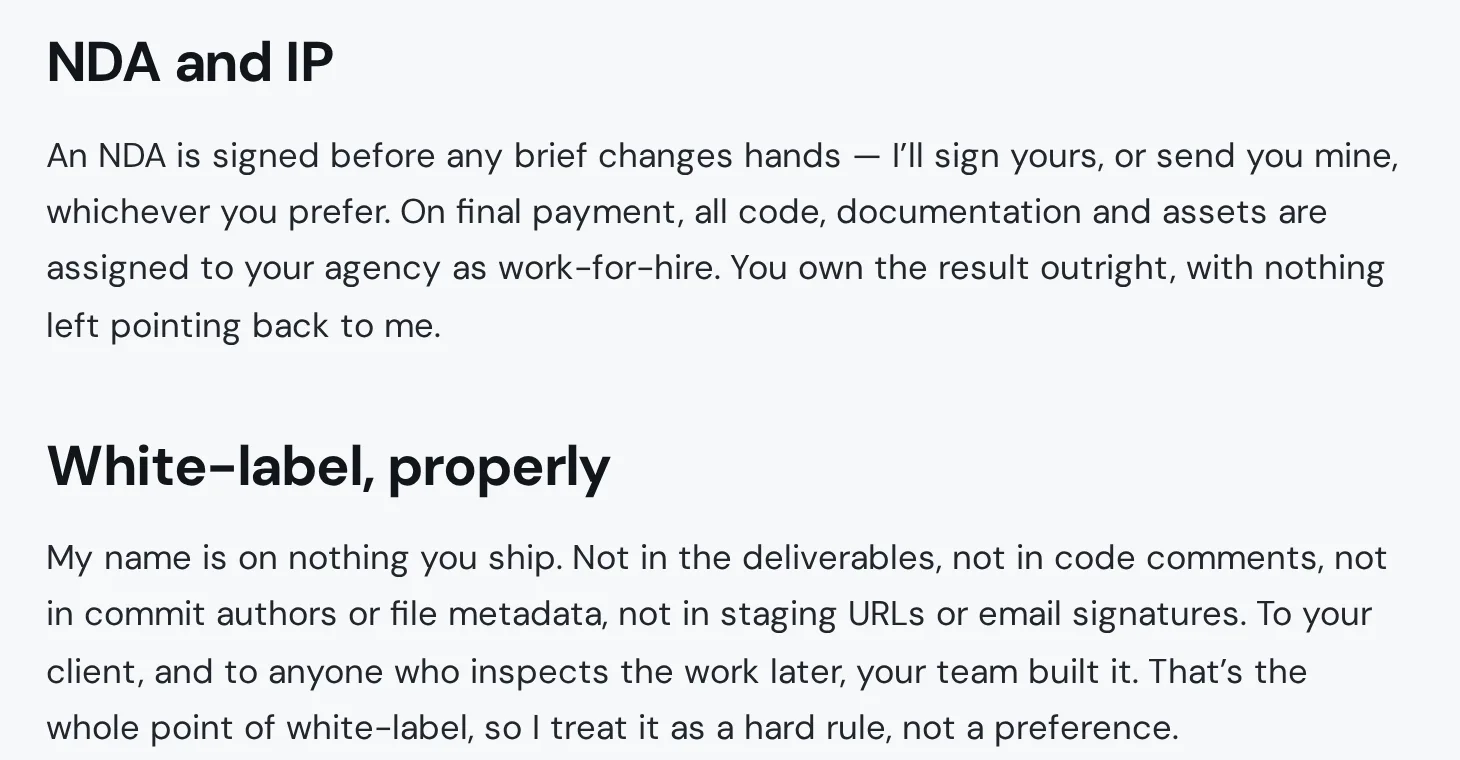
On my side, my name appears nowhere the client could see it: not in deliverables, code comments, commit authors, file metadata or staging URLs. I keep it that way so the client deals only with you. I'd still rather the agencies I work with describe the arrangement honestly when they're asked.
What to say, depending on how they ask
The question arrives in different forms. Match the length of the answer to how hard the client is pushing; a long explanation in reply to a passing question can sound defensive.
The casual question
On a call, in passing: "Who's actually building this?"
"We bring in a senior PrestaShop developer we work with for platform-level work. I run the project and I'm your contact, and nothing goes to you without coming through us first."
If they don't follow up, leave it there.
The direct question
"Is that someone on your staff?"
"No, they're an independent specialist we subcontract to. They're under NDA with us, everything they build belongs to you once it's paid for, and we're responsible for the work under our contract with you."
Each part of that has to be true before you say it. The NDA should be signed before the developer sees a brief. Ownership has to pass in writing, which is a contract point rather than a turn of phrase; I've covered how that works in who owns the code when a white-label developer builds it. If you can't say those sentences honestly yet, get the NDA and the assignment signed first.
"Can I talk to the developer directly?"
This request can come from a technical question the client wants answered, or from wanting reassurance that the person is competent. Both can be handled through you:
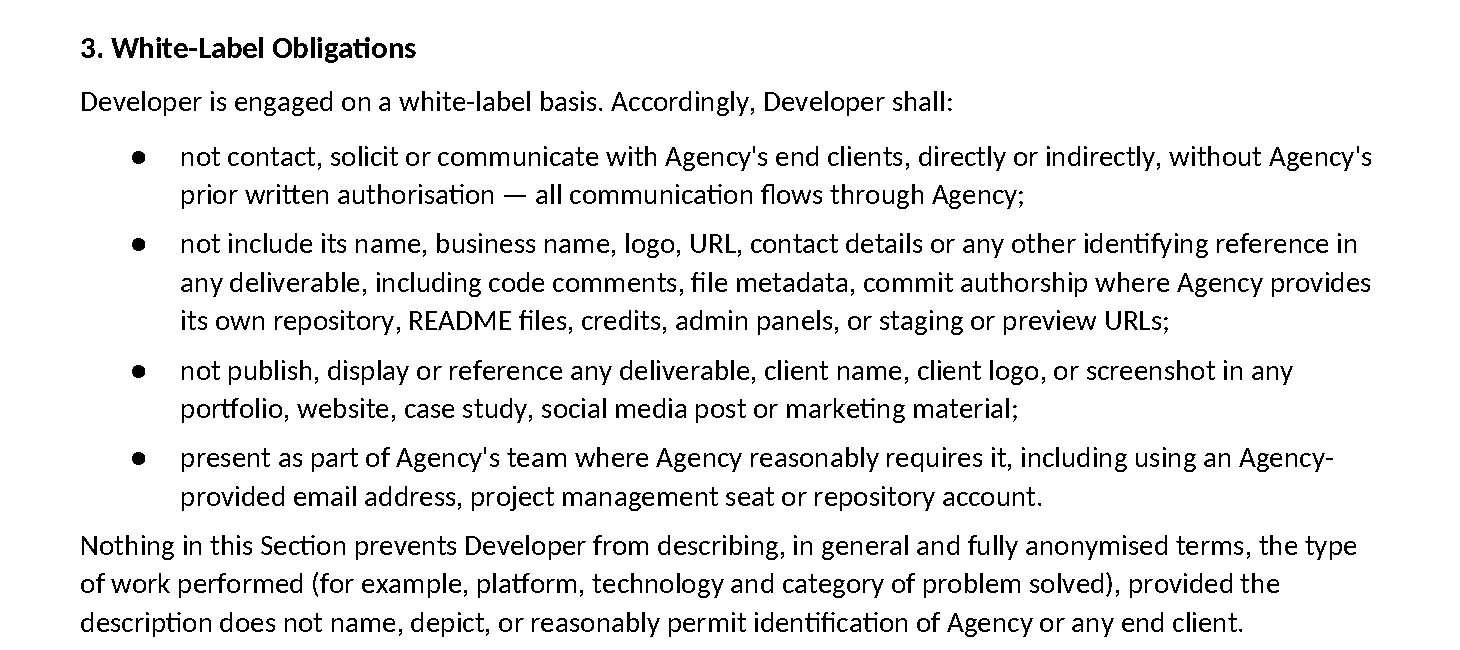
"We keep communication through us so nothing gets lost between people. Send me your questions and I'll get you a written answer, or I'll bring the technical detail to a call."
A white-label developer who contacts your client is working against you. I never contact an agency's client, and it's worth asking anyone you're considering how they handle this; it's one of the questions to ask a white-label developer before you send the first brief.
"Where are they based?"
If asked, answer plainly. If your developer is in Europe, as I am, mention what the time difference does for the client: a brief sent at the end of a US day is often done by the next morning, and there's a morning overlap for calls.
When white label development client disclosure is required
Some clients aren't asking out of curiosity. Your master services agreement or statement of work with them may include a subcontracting clause that requires notice or consent before anyone else works on the project. Read your contracts before the question comes up. If there is such a clause and it hasn't been followed, raise it with the client yourself and get the consent the clause asks for.
Personal data is the second case. A developer working on a store can usually see customer names, addresses and order history. If the store holds personal data about people in the EU, the GDPR may apply, and Article 28 of the GDPR says a processor shall not engage another processor without the controller's prior specific or general written authorisation. Whether your agency and your developer count as processors depends on the setup, and that's a question for your lawyer.
Larger clients also send security questionnaires asking whether third parties have access to their systems. Answer those accurately, which means answering "yes" to third-party access if a developer has a login. A signed questionnaire is a document the client may hold you to later.
Where disclosure is required, check what the clause or the law actually asks for. Telling the client that a subcontractor exists, what they can access and on what terms doesn't involve sharing what you pay them or your margin, unless the contract specifically asks for that. If the contract requires a named party, name them; if it doesn't, a description of the developer's role plus confirmation of the NDA is what I'd offer.
The less the developer can reach, the easier these questions are to answer. Working on a staging copy with a separate login you can revoke means you can tell the client exactly what was accessible. I've set out how to do that in how to give a white-label developer access without handing over the live site.
Set it up before anyone asks
Your answer is only as solid as the arrangement behind it. These are worth having in place before the first brief goes out:
- A clause in your client contract that lets you use subcontractors and keeps you responsible for their work.
- An NDA with the developer, signed before they see anything about the client.
- A written agreement that assigns the work to you on payment, so you can pass ownership on to the client.
- Access arranged so the developer works on staging with their own credentials, not on the live store with a shared admin login.
- One agreed sentence for the whole account team, so the answer on a call matches the answer in an email.
The last item is easy to skip. If the account manager says "our developer" and the project lead says "a partner we use", the client will notice the difference and may ask which one is true. Put the agreed sentence in your account notes or onboarding document so new staff use it too.
The handover is the other place the arrangement shows. When a job ends, I hand back the code plus a short written summary, and that summary should be something you can put in front of the client as your own document without editing a stranger out of it. What a good one contains is in what a white-label developer should hand back when the job is done.
Working through this on a client's store? Send me the URL and what you've found so far, and I'll tell you what I would check first and whether it needs more than a checklist, NDA first if you want one. Send me the URL.