Ask for a fixed price when the job can be written down precisely enough that you and the developer would agree, afterwards, on whether it was done. That covers a defined feature, a migration with a known catalogue, or a bug that has already been diagnosed. Pay hourly, with a ceiling you agree in writing, when nobody can yet say what is wrong or how much of it there is. For anything in between, pay for a short diagnosis first and get a fixed price for the fix once you know what the fix is.
The choice matters more to an agency than to anyone else involved, because you usually quote the client before the developer has opened the code. The pricing model you agree with your subcontractor decides how much of that risk stays with you.
What a fixed price buys you
A fixed price moves the risk of overrun from you to the developer, and the developer prices that risk in. A sensible quote is the job plus a margin for whatever the brief doesn't show. On well-defined work little is hidden, so the margin is small. On vague work it should be larger. If a fixed price for a vague job comes back looking no higher than one for a clear job, ask the developer how they read the brief, because one of you may have understood the scope differently.
Not sure which model fits a job? Send me the brief and I'll tell you whether I can fix the price or need to look inside first, and why. Send me a brief.
For an agency, the useful part is that a fixed price from your subcontractor lets you give a fixed price to the client and know your margin before anyone starts. You can sell the job and schedule it without watching a timesheet.
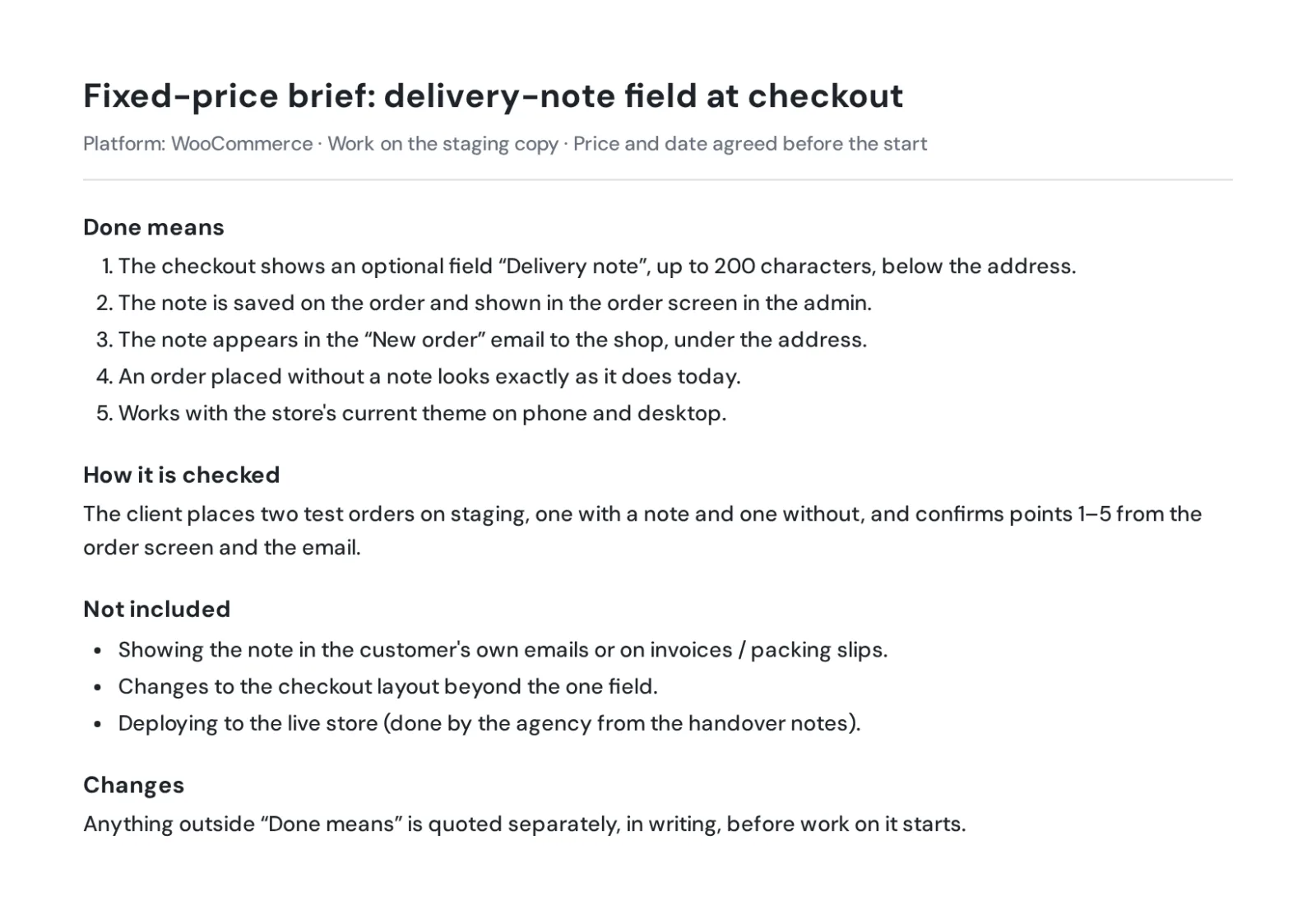
For that to hold, the brief needs to say in writing what will exist, or behave differently, when the job is done, described well enough that the client could check it on staging themselves. It should also list what is excluded (historical data, third-party modules, design changes and content are the usual candidates), say where the work happens and how it reaches the live store, and say how a change will be priced if the client asks for something new halfway through.
You can describe a custom WooCommerce checkout field that saves to the order and appears in the admin email that way. The same goes for a migration where the product, customer and order data are known and the URL redirect map is part of the deliverable. "Make the store faster" can't be described that way until someone has measured what is slow.
When hourly is the honest answer
Some work has no knowable size until someone is inside it. One example is a PrestaShop store the client inherited from a developer who left, with undocumented overrides (edits that replace parts of PrestaShop's core classes) and modules from vendors who have since disappeared. Another is an ERP or CRM sync that fails on some nights and not others. The cause could be a timeout, a malformed record or an API change on the other side, and sometimes it is more than one of those in turn.
Any fixed price on work like that rests on an assumption about what will be found. If the developer assumes the worst, you pay for problems the store may not have. If they assume the best, the price comes with conditions, and you find out about them partway through the job. When I can't see enough of a job to price it, I say so and send an estimate, labelled as an estimate.
Hourly billing has one real weakness for an agency: there is no ceiling, which makes it hard to quote the client. If you buy hourly work from any developer, ask before you start how you will hear about the hours approaching the estimate, and what that update will contain, ideally what has been found so far and what is thought to remain. If the client's budget depends on a ceiling, agree it in writing before work begins.
Splitting unknown work into a diagnosis and a fix
A lot of store problems arrive half-defined, as "the upgrade broke the checkout" or "orders stopped reaching the ERP last week". For these I think a two-step arrangement works best.
- A short, time-boxed diagnosis on a staging copy of the store, paid hourly against an agreed limit or as a small fixed fee. It ends with a written finding that says what is wrong, why, and what fixing it involves.
- A fixed price for the fix, based on that finding.
Between the two steps you have something written to put in front of the client before the larger spend is approved. If the fix turns out to be bigger than the client's budget, you can stop after step one, and the client keeps a finding they can act on later or hand to someone else.
A hacked store usually fits this pattern. The first job is finding out how far the damage goes, and once that is known, the clean-up and the hardening afterwards can often be priced. PrestaShop upgrades fit it too. The uncertainty sits in which modules and overrides will survive, so the diagnosis carries most of it, and the upgrade itself can often be priced once that is done. There is more on that kind of install in So you've inherited a PrestaShop client. For integrations that fail intermittently, see why a client's ERP sync keeps breaking.
Matching what you sell the client to what you buy
If you have quoted the client a fixed price and you are buying open hourly work underneath it, every hour over the estimate is paid by you. Recovering it from the client means reopening a price they have already approved.
When a client wants a fixed price for something open-ended, sell the diagnosis as its own line first, at a fixed fee, and quote the fix once the finding is in. Each stage of your quote to the client then matches a stage of what you bought from your developer.
Where the client is already on an hourly arrangement with you, buying hourly from your developer is fine, as long as the ceiling you agree with the developer sits comfortably inside the one you agreed with the client.
Ongoing work: retainers sit between the two
Maintenance, small changes and the requests a live store produces week to week are awkward under both models. A fixed price for each one means a quote cycle for a twenty-minute job. Hourly billing for each one means a pile of small invoices for someone to reconcile.
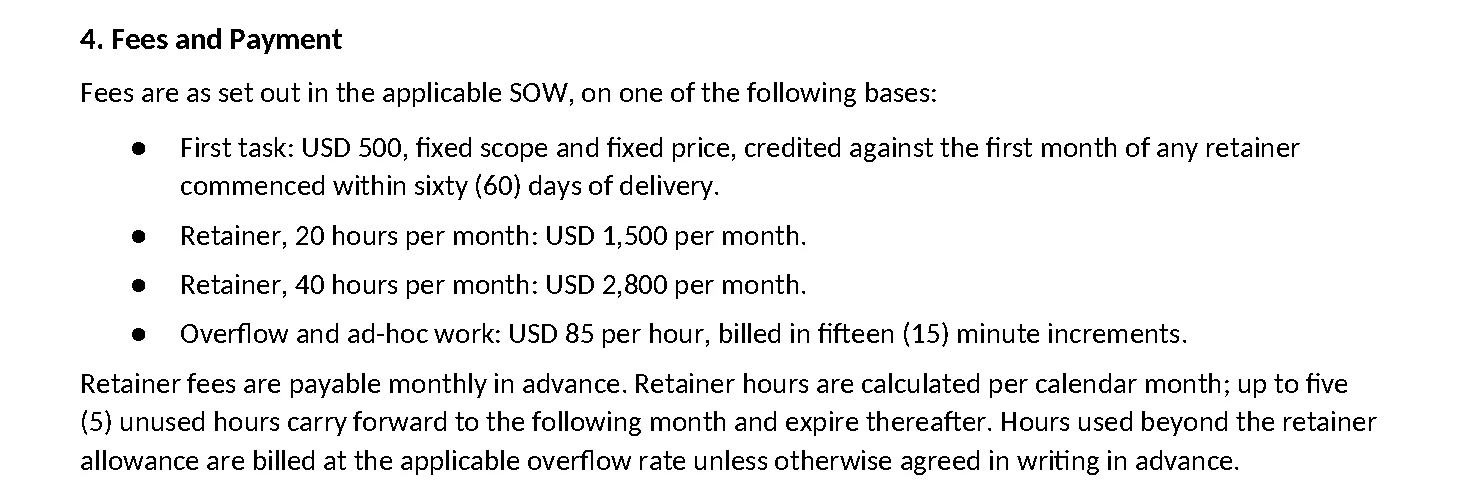
A monthly block of hours suits that work better. You know the cost each month, the developer keeps time free for your clients, and you can spend the hours on whatever comes up without a new quote. Before you agree to one, ask what happens to unused hours and what rate applies when a month needs more than the block.
The pricing published on my homepage is set up along the same lines: the first task is a fixed price, ongoing work is a monthly retainer measured in hours, and hours beyond the retainer are billed at an overflow rate. The figures are on that page. When a brief arrives (the URL, the platform and what's stuck), I usually reply within one business day with the scope and either a fixed price or an estimate, and I say which one it is.
What makes either price trustworthy
A fixed price is only as reliable as the scope written underneath it. Before you quote the client on the back of one, make sure the exclusions are listed and there is an agreed way to price changes. "Done" should be defined by something you can check on staging, not by the developer's word. If any of that is missing, get it in writing before your own quote goes out.
Hourly work needs different checks: how time is logged, how detailed the log you receive will be, and how you will hear about the hours as they approach the estimate. Under either model, the deliverable should include the code and a written summary of what changed. On hourly work that summary is the main record of what the hours bought. What a white-label developer should hand back covers it in more detail, and the pricing questions belong alongside the others in the questions to ask before you send the first brief.
Got a brief like this? Tell me the URL, the platform and what's stuck, and I'll come back with scope and a price, NDA first if you want one. Send me a brief.